
 “The Death Penalty Is Too Easy”: April Jones’ Sister Breaks Silence After Killer Is Attacked Again

The chilling echo of a child’s laughter silenced forever has haunted the Welsh valleys for nearly 14 years, but fresh wounds have reopened with brutal force. Mark Bridger, the monster convicted of abducting and murdering five-year-old April Jones in 2012, has once again felt the sting of prison justice—attacked for the second time in as many years. As reports of the latest ᴀssault surfaced, April’s half-sister, Hazel Jones, now 31 and a mother grappling with her own fears, broke her long-held silence with unfiltered fury: “He deserves everything he’s getting. He literally deserves it all.” Her words, raw and resolute, cut through the fog of time, reminding a nation that some horrors never fade, and justice, even behind bars, can be a slow-burning torment.

The saga began on a seemingly ordinary autumn evening in the sleepy town of Machynlleth, Powys, Wales. October 1, 2012, started like any other day for the Jones family. April Sue-Lyn Jones, a spirited girl with cerebral palsy who had defied the odds since her premature birth on April 4, 2007, had just returned from swimming lessons. Her parents, Coral and Paul Jones, had attended a parents’ evening at her school, buoyed by reports of her progress. By 7 p.m., April was outside on her pink bicycle, pedaling joyfully with friends on the Bryn-y-Gog estate—a close-knit community where children played freely under the watchful eyes of neighbors. The air was crisp, the streetlights flickering on, and no one suspected that evil lurked in the shadows.
Witnesses later recounted the fateful moment: around 7:15 p.m., April approached a grey Land Rover Freelander parked nearby. The driver, a local man known casually in the area, coaxed her inside. She vanished without a trace. What followed was a parent’s worst nightmare unfolding in real time. Coral, sensing something amiss when April didn’t return, alerted the police. By nightfall, the alarm had spread, and the small town mobilized. Neighbors knocked on doors, flashlights pierced the darkness, and calls echoed through the hills. But as hours turned to days, hope dimmed. This wasn’t a simple case of a child wandering off; it was something far more sinister.
The search for April became the largest missing person operation in UK police history. Thousands of volunteers descended on Machynlleth, combing forests, rivers, and rugged terrain. Sniffer dogs barked through the underbrush, helicopters thumped overhead with thermal imaging, and divers plunged into the icy waters of the River Dyfi. Mountain rescue teams scaled cliffs, and even celebrities lent their voices—Prime Minister David Cameron appealed directly to the public, urging anyone with information to come forward. Pink ribbons, April’s favorite color, adorned lampposts and fences, symbolizing a community’s collective prayer. For five agonizing days, the nation held its breath, glued to news updates, willing a miracle.
But miracles were in short supply. On October 6, 2012, police arrested Mark Bridger, a 46-year-old former slaughterhouse worker and lifeguard who lived in a rented cottage in the nearby village of Ceinws (also known as Esgairgeiliog). Bridger, a father of six with a troubled past marked by failed relationships and a fascination with the macabre, initially spun a web of lies. He claimed he had accidentally run over April while drunk, panicked, and disposed of her body in a haze. But inconsistencies piled up: no damage to his vehicle, no blood evidence from a collision, and a seven-year-old playmate’s eyewitness account of April willingly entering the car contradicted his story.
A forensic sweep of Bridger’s home revealed the gruesome truth. Blood matching April’s DNA soaked his living room and bathroom. Tiny bone fragments—later identified as parts of a child’s skull—were discovered in his wood-burning stove, charred and scattered. His computer harbored a chilling cache: thousands of images of child abuse, including pH๏τos of local girls scraped from Facebook, and searches for notorious child murders like those of Holly Wells and Jessica Chapman in Soham. Bridger’s obsession was laid bare—he had fantasized about abducting and harming children, and April, vulnerable with her mild disabilities, became his tragic victim.
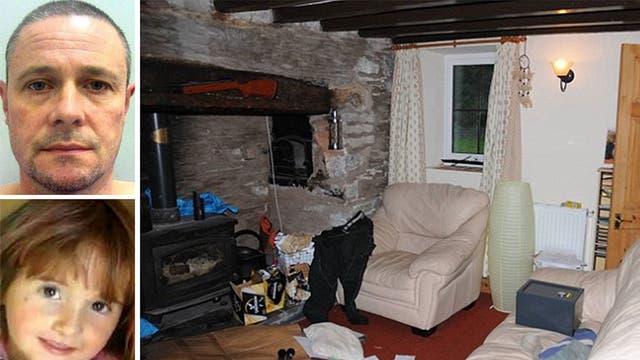
The trial at Mold Crown Court in 2013 was a harrowing spectacle. Prosecutors painted Bridger as a “fantasist obsessed with child murder and pornography,” who lured April into his vehicle, Sєxually ᴀssaulted her, and killed her to cover his tracks. He dismembered her body, burning parts in his fireplace and scattering the rest—likely in the nearby river—to evade detection. The jury took just four hours to convict him of abduction, murder, perverting the course of justice, and unlawfully disposing of a body. Mr. Justice Griffith Williams, in sentencing Bridger to a whole-life tariff—the rarest and most severe punishment in British law—described his crimes as “truly horrific” and driven by “Sєxual motivation.” Bridger, impᴀssive in the dock, would spend the rest of his days in prison, joining the likes of Ian Brady and Peter Sutcliffe in the UK’s most secure facilities.
Yet, for the Jones family, the verdict brought no closure. April’s body was never fully recovered—only those bone fragments offered grim confirmation of her fate. No grave to visit, no final goodbye. The void gnawed at them relentlessly. Paul Jones, April’s doting father, descended into a spiral of grief. “A part of him went completely and he never came back,” Hazel later reflected. In 2018, Paul was struck by encephalitis, a debilitating brain disease that eroded his memory and health. Confined to a specialist unit in Swansea, he relived the horror anew each time his fading mind grasped the truth. He died on May 14, 2025, at age 56, without ever learning where his daughter’s remains lay hidden. His other daughter, Jazz (Jazmin), 29, shared the family’s heartbreak: “It was very unexpected and we are all in shock… heartbroken.” Jazz, who has chosen to shield herself from the full details of Bridger’s depravity, announced the news, underscoring the ongoing toll.
Hazel Jones, Paul’s daughter from a previous relationship and April’s half-sister, was 18 and weeks from giving birth when the abduction shattered her world. Living in Aberaeron, she received the devastating call from her mother: “April’s missing.” Shock froze her in place. “It just took a couple of seconds that felt like bloody minutes to actually process what the hell she was saying.” Rushing to Machynlleth, Hazel joined the vigil, but the media swarm overwhelmed her. Reporters camped outside her door, hounding her for comments. She retreated inward, focusing on her pregnancy amid the chaos. Her last memory of April—a giggling girl in army pyjamas making H๏τ chocolate with their dad in the kitchen—became a cherished anchor in the storm.
When the truth emerged, Hazel was “left in pieces.” Giving birth to her daughter Amelia shortly after, she navigated joy tainted by sorrow. “When Dad and Coral came to see her in the hospital, they were just shocked because she looked like April.” Now a mother of three—Amelia (12), Ethan (9), and Hefin (6)—Hazel’s parenting is shadowed by paranoia. “The anxiety from what happened to my younger sister never left me,” she confessed. “I’m terrified to let my own children grow up.” At five, Amelia mirrored April’s age and appearance, triggering waves of grief. “She had only been on this earth for five years… and that was taken away from April.” Hazel keeps a box of mementos—newspaper clippings, pH๏τos—to educate her kids about the dangers, refusing to sugarcoat the world’s cruelties.
The family’s fractures run deep. Relationships strained under the weight of unspoken pain; some relatives no longer speak. Coral Jones, April’s mother, has campaigned tirelessly for child safety reforms, including “April’s Law” to monitor Sєx offenders more stringently. The case spurred legal changes, like enhanced sentencing for child killers and better online protections against child exploitation. Yet, the absence of April’s body remains a cruel taunt—Bridger’s final act of control.
Fast-forward to 2025: Bridger, incarcerated at HMP Wakefield (dubbed “Monster Mansion” for housing Britain’s worst offenders), faced vigilante justice. In July 2025, an inmate attacked him, leaving grazes on his hands. It was his second ᴀssault overall—the first, shortly after his 2013 jailing, involved a razor-blade slash to his face requiring sтιтches. The Prison Service placed the ᴀssailant on report, but details remained sparse. Hazel, upon hearing, vented to The Sun: “I’ve got kids myself now and it’s scary to know there are people like that living on your doorstep. I am glad he’s in prison for life. He’s going to carry on getting hurt.”
Then, in January 2026, Bridger was targeted again. Details emerged scantily—another inmate confrontation at Wakefield, echoing the prison’s volatile undercurrents. This “second time” in recent memory amplified Hazel’s resolve. In her first full interview with the Daily Mail, published February 8, 2026, she unleashed pent-up rage. “Chemically castrating paedophiles is 100 per cent right. I’m so backing that,” she declared, endorsing controversial proposals to neuter Sєx offenders chemically. “They should be made to suffer. The death penalty is an easy way out. He didn’t give April an easy way out, did he? Make him suffer, make him live every day because he’s not coming out. Make him live in fear.”
Hazel’s emergence from silence marks a turning point. For 13 years, she mourned privately, but her father’s death unlocked the floodgates. “It’s been 13 years now and it’s still not actually sunk in. I still don’t believe it… I’m still waiting to wake up from this nightmare.” Her story humanizes the statistics of child abduction—around 140,000 children go missing annually in the UK, though most return safely. April’s case, however, exposed systemic vulnerabilities: lax monitoring of predators like Bridger, who had prior allegations dismissed, and the digital dangers of social media, where he harvested images.
Bridger’s attacks spark debate: Is prison violence poetic justice or a failure of the system? Advocates argue whole-life sentences suffice, but families like the Joneses see it as fitting retribution. “He literally deserves it all,” Hazel insists, her voice a beacon for survivors. Yet, she yearns for more—Bridger’s confession to April’s burial site. “All I think is that [Dad] is now back with April and back to a peaceful life.”
As Machynlleth heals, pink ribbons still flutter on anniversaries. April’s legacy endures in awareness campaigns, like the Child Rescue Alert system inspired by her case. Hazel’s candor stimulates reflection: How do we protect the innocent? What price for monsters? In her words, the fight continues—not for vengeance, but for a world where children bike freely without fear. The nightmare lingers, but voices like Hazel’s ensure it won’t be forgotten.
