He Wasn’t Supposed to Remember—But His Heart Nearly Stopped Before Life Began
It started with something so ordinary that no one could have predicted what would come next: a fever.
For baby Fletcher St. Jean, those early days looked like any other newborn’s journey—quiet moments, gentle breathing, the fragile rhythm of a life just beginning. But beneath that calm surface, something far more dangerous was unfolding. What first appeared to be a routine infection would soon spiral into a life-threatening emergency that pushed the limits of modern medicine—and redefined what survival can look like.
A Sudden Turn No One Saw Coming
Fletcher was brought to Cincinnati Children’s Hospital Liberty Campus after developing a persistent fever. At first, doctors suspected a common culprit in infants: an E. coli infection. It’s a diagnosis physicians encounter regularly, and one that, in most cases, can be managed effectively with prompt treatment.
But Fletcher’s case refused to follow the expected path.
Without warning, his condition took a dramatic and terrifying turn. His heart slipped into ventricular fibrillation, a chaotic and ᴅᴇᴀᴅly rhythm that prevents the heart from pumping blood effectively. In such moments, survival is measured in seconds.
There was no time to hesitate.
A Race Against Time
Medical teams moved immediately. Emergency defibrillation—an electric shock delivered to restore a normal heartbeat—was performed. It worked. Fletcher’s heart restarted.
But while the immediate crisis had pᴀssed, a deeper and more troubling question remained: Why had this happened at all?
Ventricular fibrillation is rare in infants, especially without an obvious structural heart defect. For doctors, the mystery was as urgent as the initial emergency. If the cause couldn’t be identified, the risk of it happening again would remain—a silent threat hanging over Fletcher’s life.
Searching for Answers
Fletcher underwent extensive testing. Specialists examined every possibility, from infection-related complications to underlying genetic conditions. Eventually, the answer emerged.
He had a rare cardiac rhythm disorder—a condition affecting the electrical system of the heart rather than its structure. Unlike many heart issues that can be seen on imaging, rhythm disorders often hide in plain sight, only revealing themselves during dangerous episodes like the one Fletcher experienced.
The diagnosis was both a relief and a new challenge.
It explained what had happened—but it also meant that Fletcher could face another sudden cardiac event at any time.
A Life-Saving Decision
Doctors and Fletcher’s family now faced a critical decision: how to protect him from a future episode that might not allow for a second chance.
The solution was both innovative and extraordinary.
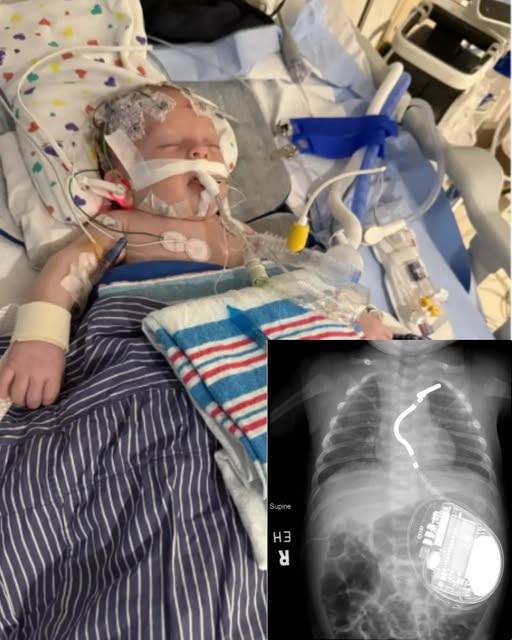
They chose to implant an EV-ICD (extravascular implantable cardioverter-defibrillator)—a device designed to continuously monitor the heart’s rhythm and deliver an immediate shock if a life-threatening arrhythmia occurs.
These devices are typically used in older patients. Implanting one in a baby as small as Fletcher was virtually unheard of.
In fact, Fletcher became the youngest and smallest patient ever to receive this type of device.
Precision Medicine at Its Limits
The procedure required careful planning and exceptional precision. Every aspect—from the size of the device to the placement of its leads—had to be adapted to Fletcher’s tiny body.
Unlike traditional defibrillators, the EV-ICD is designed to avoid direct contact with the heart and blood vessels, reducing long-term risks. For a child expected to grow and develop, this approach offered a crucial advantage.
Still, the stakes were enormous.
This wasn’t just about treating a condition—it was about safeguarding an entire future.
A Quiet Guardian
Today, Fletcher’s life looks remarkably different from those early, uncertain days.
He plays. He laughs. He explores the world with the boundless curiosity of a toddler. To anyone watching, there’s little to suggest how close he once came to losing everything before it had even begun.
And yet, beneath that normalcy, something extraordinary is always at work.
The EV-ICD implanted inside him acts as a silent guardian, constantly monitoring his heartbeat. If danger arises again, it will respond instantly—without hesitation, without warning, and without needing anyone else to intervene.
It is, quite literally, a life-saving presence that never sleeps.
More Than a Medical Story
Fletcher’s journey is not just about advanced technology or clinical expertise—though both played critical roles. It is also a story about timing, resilience, and the fragile unpredictability of life.
Moments mattered. Decisions mattered. And the ability to act quickly, guided by knowledge and experience, made all the difference.
For his family, the experience reshaped everything. What began as a routine hospital visit became a life-altering ordeal—one that tested their strength, their trust, and their hope.
The Future He Gets to Live
What makes Fletcher’s story so powerful is not just what he survived, but what lies ahead.
Because of the intervention he received, he now has something that once seemed uncertain: time.
Time to grow.
Time to learn.
Time to become someone beyond the hospital walls where his life was saved.
And while he may never remember the moment his heart stopped, or the hands that brought him back, the impact of those moments will echo through everything he experiences moving forward.
Where Medicine Meets Humanity
Stories like Fletcher’s highlight the evolving frontier of pediatric care. They show how innovation is pushing boundaries—making it possible to treat conditions once considered untouchable in patients so small.
But they also remind us of something deeper.
Behind every medical breakthrough is a human story. A child. A family. A moment when everything hangs in the balance.
In Fletcher’s case, love, medicine, and timing aligned in the most critical way possible.
Just in time to keep his heartbeat going. ❤️